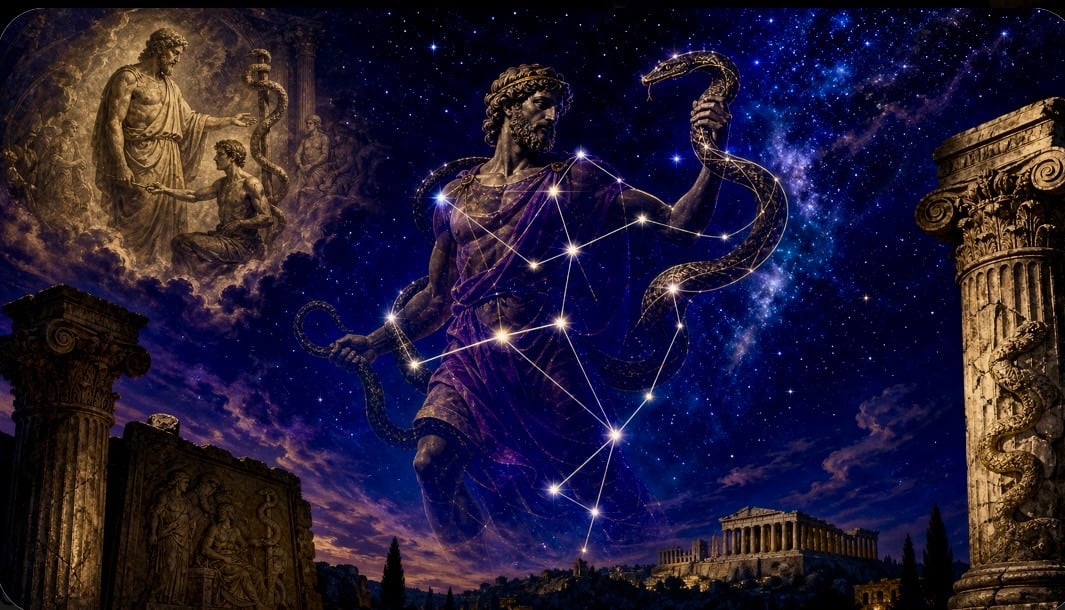
Ophiuchus: The 13th Zodiac Constellation, Ancient Healing Wisdom, Spiritual Symbolism, and Medical Astrology
Discover the mythology, astronomy, zodiac controversy, spiritual meaning, and traditional medical astrology associated with Ophiuchus, the mysterious Serpent Bearer.
The Celestial Nurse A Medical Astrologer & Herbalist
Introduction: Discovering Ophiuchus
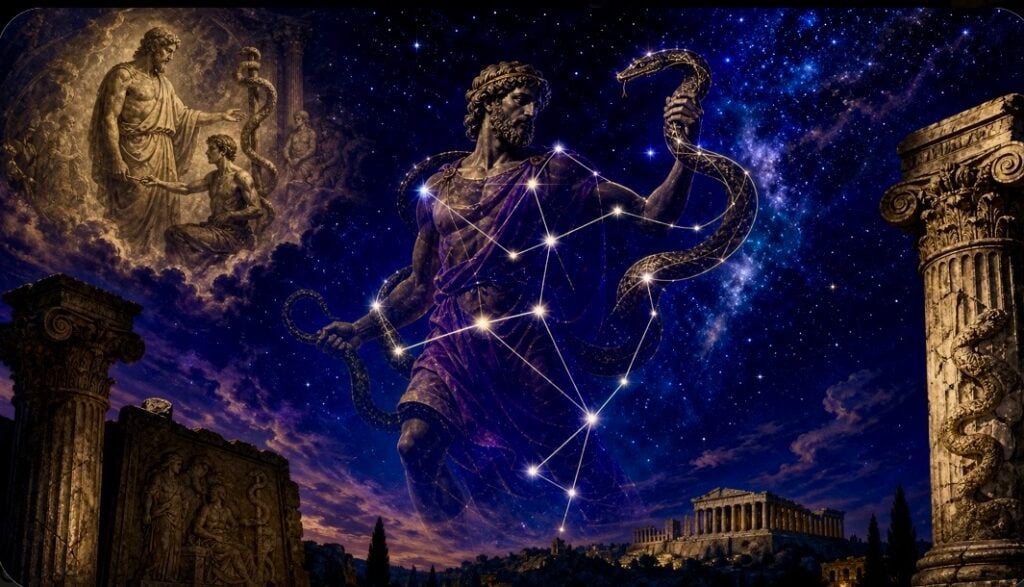
Among the many constellations that fill our night sky, Ophiuchus stands out for its fascinating connection to healing, transformation, ancient mythology, and the debate surrounding the 13th zodiac sign. Known as the Serpent Bearer, Ophiuchus represents a figure holding a snake and is traditionally associated with Asclepius, the ancient Greek god of medicine and healing.
Although Ophiuchus is officially recognized as one of the 88 constellations, it is not included among the 12 signs of traditional Western astrology. This distinction has sparked curiosity among astronomers, astrologers, and spiritual seekers alike.
Beyond its astronomical identity, Ophiuchus has become a powerful symbol of renewal, wisdom, hidden knowledge, and the relationship between life and death. Its association with healing also makes it particularly interesting to explore through the historical lens of medical astrology, an ancient practice that attempted to connect celestial movements with the human body.
In this article, we will explore the science, mythology, astrological interpretations, and medical traditions associated with Ophiuchus while distinguishing historical beliefs and symbolic interpretations from modern scientific evidence.
1. What Is the Ophiuchus Constellation?
Ophiuchus is a large constellation located near the celestial equator, between Scorpius and Sagittarius. Its name comes from Greek and translates to “Serpent Bearer,” reflecting its traditional depiction of a person holding a snake.
The Sun’s apparent path across the sky, known as the ecliptic, passes through Ophiuchus. This makes it one of the constellations crossed by the Sun during its yearly journey as observed from Earth.
According to modern astronomical constellation boundaries, the Sun passes through Ophiuchus approximately from November 30 to December 18, although exact dates can vary slightly by year.
Ophiuchus contains several interesting astronomical objects:
- Rasalhague: The constellation’s brightest star, a binary star system.
- Cebalrai: A red giant star located within Ophiuchus.
- Sabik: A binary star system made up of two stars.
- The Rho Ophiuchi cloud complex: A spectacular region of gas and dust where astronomers study the formation of stars.
Ophiuchus is best placed for evening observation during the Northern Hemisphere’s summer months. Its position makes it a rewarding target for stargazers exploring the region near Scorpius and Sagittarius.
For further astronomical information, see NOIRLab’s Ophiuchus constellation guide.
2. The Mythology of Ophiuchus: The Serpent Bearer and the God of Healing
Ophiuchus is commonly associated with Asclepius, the Greek god of medicine, healing, and physicians.
According to Greek mythology, Asclepius possessed exceptional healing abilities. Some stories describe him as becoming so skilled that he could restore life to the dead, challenging the natural order and attracting the attention of Zeus.
In one version of the myth, Zeus struck Asclepius down with a thunderbolt because his powers threatened the balance between life and death. Asclepius was subsequently honored among the stars, becoming associated with the constellation Ophiuchus.
The serpent is central to this symbolism. Snakes shed their skins, making them enduring symbols of renewal, regeneration, and transformation in many cultural traditions.
The connection between Asclepius and the serpent survives today in the Rod of Asclepius, a staff entwined by a single snake that is widely recognized as a symbol of medicine.
From a symbolic perspective, the mythology of Ophiuchus explores several timeless themes:
- Healing and restoration after suffering.
- The pursuit of knowledge and wisdom.
- The responsibility that accompanies power.
- Transformation through difficult experiences.
- The delicate boundary between life and death.
These themes help explain why Ophiuchus has become so appealing to people interested in spiritual development and the symbolism of healing.
3. Is Ophiuchus Really the 13th Zodiac Sign?
One of the most frequently asked questions about Ophiuchus is whether it should be considered the 13th zodiac sign.
The answer depends on whether we are discussing astronomy or astrology.
Astronomically, the Sun passes through 13 constellations along the ecliptic, including Ophiuchus. The familiar zodiac signs, however, belong to an astrological system traditionally divided into 12 equal sections of 30 degrees each.
In Western tropical astrology, the signs are anchored to the seasons rather than the current boundaries of the astronomical constellations. Consequently, the zodiac sign called Scorpio is not identical to the constellation Scorpius in the modern sky.
Ophiuchus has not been officially added to the traditional Western zodiac, and NASA has not introduced a new astrological sign.
Nevertheless, some modern astrological interpretations treat Ophiuchus as a hypothetical 13th sign and associate it with people born around November 30 through December 18.
Popular descriptions of this proposed sign often include:
- Curiosity and a desire to discover hidden truths.
- Independence and unconventional thinking.
- Compassion and an interest in helping others.
- Personal transformation and resilience.
- A fascination with mysteries, healing, and wisdom.
These characteristics are part of modern astrological interpretation, not scientifically established personality traits. The astronomical dates also should not be confused with the conventional dates of the 12-sign zodiac.
4. The Spiritual Meaning of Ophiuchus
Ophiuchus has acquired a rich symbolic identity in modern spiritual discussions. Its imagery of a person holding a serpent provides a starting point for exploring healing, self-discovery, and the transformation of difficult experiences into wisdom.
The serpent as a symbol of renewal
A snake’s ability to shed its skin is often interpreted as a metaphor for releasing the past and beginning again.
In a spiritual context, this can represent letting go of outdated beliefs, moving beyond painful experiences, and embracing personal growth.
The healer archetype
Because of its association with Asclepius, Ophiuchus is often linked to the archetype of the healer.
This does not necessarily mean physical medicine alone. Symbolically, healing may include emotional recovery, learning to understand oneself, supporting others, or developing greater compassion.
The pursuit of hidden knowledge
Ophiuchus is also associated in modern interpretations with curiosity and the desire to look beyond surface appearances.
Its symbolism invites questions about the relationship between knowledge and responsibility, particularly when learning involves sensitive subjects such as health, mortality, and human vulnerability.
Transformation through adversity
The mythology of Asclepius and the image of the serpent can also represent the idea that difficult experiences may become opportunities for growth.
These interpretations can provide meaningful material for reflection, journaling, and creative exploration. However, they are symbolic associations rather than evidence that the constellation determines an individual’s spiritual abilities or life path.
5. Medical Astrology: The Historical Connection Between the Stars and the Human Body
Medical astrology is a historical branch of astrology that attempted to connect the positions of celestial bodies with human health, bodily systems, illness, and treatment.
Known in historical traditions through concepts such as melothesia, the association of zodiac signs with body parts was developed in the ancient world and became influential in Greek, Roman, medieval, and early modern medicine.
Practitioners believed that the Sun, Moon, planets, and zodiac signs could offer information about a person’s constitution, the timing of illness, and the appropriate time for certain treatments.
For example, traditional astrological medicine associated Aries with the head and Pisces with the feet. The entire zodiac was sometimes represented as a symbolic human figure known as the Zodiac Man.
In medieval and early modern Europe, some practitioners used astrological calendars when deciding when to administer remedies, collect medicinal plants, or perform procedures such as bloodletting.
These practices reflected the medical knowledge and cosmological beliefs of their time. They are important subjects in the history of medicine, but their historical influence should not be mistaken for scientific validation.
For more historical context, consult the University of Michigan’s Early Astronomy collection on astrological medicine and Yale University Library’s exhibition on medical astrology.
6. Ophiuchus and Medical Astrology: The Symbolism of the Healer
The association between Ophiuchus and medical astrology requires a distinction: Ophiuchus is not one of the 12 signs in the traditional zodiac-based body correspondence system.
Its connection to healing comes primarily from its identification with Asclepius and its symbolism as the Serpent Bearer. Modern astrologers and spiritual writers may extend these associations into interpretations of Ophiuchus as a healing archetype.
Within this symbolic framework, Ophiuchus can be explored through several themes.
Healing and restoration
The Asclepius mythology places healing at the center of Ophiuchus symbolism.
In a reflective or spiritual context, this can represent the desire to recover from setbacks, develop healthier habits, support loved ones, and pursue greater well-being.
Knowledge and the healing arts
Asclepius represents the pursuit of healing knowledge. Symbolically, Ophiuchus can therefore serve as a reminder of the importance of learning, careful observation, humility, and responsibility when dealing with the human body.
These qualities are valuable in real healthcare as well, although their importance comes from sound medical practice rather than astrology.
Transformation and the serpent
The serpent may symbolize renewal and the capacity to change. In a modern wellness context, this can be used as a metaphor for making constructive lifestyle changes, reflecting on emotional experiences, and seeking appropriate support during periods of difficulty.
Life, death, and ethical responsibility
The myth of Asclepius also raises questions about the limits of healing and the responsibility that accompanies knowledge.
This can provide a philosophical starting point for discussing the ethics of medicine, the limits of human control, and the importance of treating illness with compassion.
An important scientific distinction: There is no reliable scientific evidence that Ophiuchus, a person’s zodiac sign, or planetary positions can diagnose disease, predict individual health outcomes, or determine which medical treatment will work. Ophiuchus has no scientifically validated set of body parts or diseases that it governs. Its healing associations are mythological and symbolic.
Medical astrology should never replace medical assessment, evidence-based treatment, or advice from qualified healthcare professionals.
7. What Would an Ophiuchus-Inspired Wellness Approach Look Like?
For readers interested in the symbolism of Ophiuchus, its themes can be translated into a practical approach to personal well-being without making unsupported medical claims.
Embrace renewal. Treat the serpent’s shedding of its skin as a reminder that habits can change and new routines can be developed.
Value knowledge. Seek reliable information about health and ask qualified professionals questions when something is unclear.
Practice compassion. Recognize that healing can involve patience, support, and understanding rather than a quick solution.
Respect boundaries. Just as the Asclepius myth explores the limits of power, recognize that not every condition can be controlled through willpower or lifestyle changes.
Use reflection responsibly. Journaling, meditation, and symbolic imagery may help some people explore their experiences, but they are not substitutes for medical care when it is needed.
These ideas preserve the inspirational value of Ophiuchus while keeping the distinction between symbolism and medicine clear.
8. How to Find Ophiuchus in the Night Sky
Ophiuchus is visible from much of the Northern and Southern Hemispheres.
For observers in the Northern Hemisphere, summer is generally a favorable time to look for it.
Start by locating Scorpius, a constellation recognized by its curved tail and the bright reddish star Antares. Ophiuchus lies above and around the region north of Scorpius, with Sagittarius farther east along the ecliptic.
Look for Rasalhague near the northern part of Ophiuchus. A star chart or astronomy app can help identify the constellation’s outline and distinguish its stars from neighboring patterns.
Choose a clear night away from bright city lights if possible. Although you do not need a telescope to see the constellation, binoculars or a telescope can reveal additional stars and interesting objects in the surrounding region.
Observing Ophiuchus directly can make its connection to ancient mythology more tangible: the constellation is not merely an astrological idea but a recognizable pattern in the real night sky.
Conclusion: The Enduring Mystery of Ophiuchus
Ophiuchus occupies an unusual place at the intersection of astronomy, mythology, astrology, and the history of medicine.
As an astronomical constellation, it contains real stars and remarkable regions of space. As a mythological figure, it is associated with Asclepius, the Greek god of healing. In modern spiritual interpretations, it has become a symbol of renewal, transformation, knowledge, and the healer archetype.
Its reputation as the 13th zodiac sign reflects a genuine astronomical fact—the Sun passes through Ophiuchus—but does not mean that traditional Western astrology has officially adopted it as an additional sign.
The connection to medical astrology is equally fascinating. Historical practitioners once believed that celestial patterns could reveal information about the human body and the timing of treatment. Today, these traditions are best approached as subjects of cultural history and symbolic reflection rather than scientifically reliable medical methods.
Ultimately, the most compelling aspect of Ophiuchus may be the questions it inspires. What does healing mean? How do we transform difficult experiences into wisdom? How can the pursuit of knowledge be balanced with responsibility?
The Serpent Bearer offers a powerful image through which to explore these questions—one that connects the wonders of the night sky with enduring human interest in health, transformation, and the mysteries of life.
Editorial note: This article discusses medical astrology as a historical and symbolic tradition, not as an evidence-based method of diagnosis or treatment.
Medical Astrologer ✨& Herbalist 🌿

You May Also Like

Wellness Astrology for October 16 2026: Align Your Mind, Body, and Spirit

Medical Astrology Healing Body